Your party game
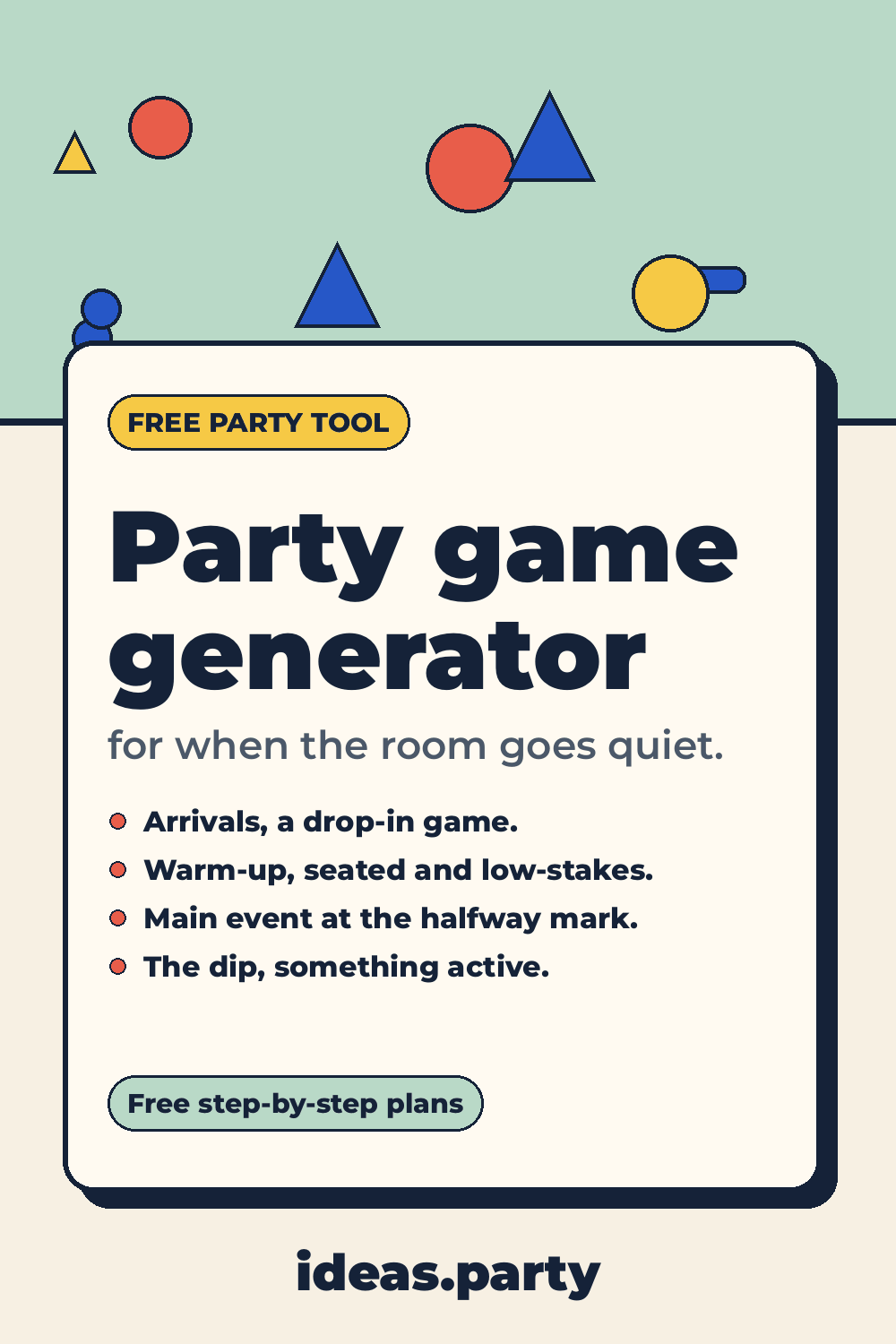
Party game generator
for when the room goes quiet.
Press the button and get one game you can start in the next five minutes: how many players it needs, how long it runs, what equipment it takes (usually none) and rules short enough to read aloud. There are more than sixty games, filtered by who is playing, the kind of energy the room needs and how many of you there are.
Random party game generator
Find a game for this room
Set who is playing and the mood. Every game comes with players, time, equipment and rules.
Who is playing
Anyone
Kind of game
Any kind
Group size
Any size
Extras
Optional
Your game lands here.
Press the button for a game with players, time, equipment and rules.
How to use the random party game generator
Set who is playing, the kind of game you need and how many people are in the room, then press Generate a game. Turn on No equipment when you are improvising with whatever is in the house. Drinking-free only is on by default, so the two drinking games only appear if you switch it off. Each result shows the player range, the time it takes, the equipment and rules short enough to read to a room. Another one works through every matching game before it repeats, and Copy link saves the game in the web address, so you can drop it into the group chat before the party. The full list sits below, grouped by audience, if you would rather plan the night on paper. For a ranked shortlist with a reason for every pick, try the party game picker; for bigger formats, such as a whole-night tournament, see party game ideas.
How to sequence games across a night
One good game does not make a game night; the order does. Most parties follow the same energy curve: slow arrivals, a peak once the room fills, and a dip somewhere after the second hour. The job is to match the type of game to each stretch of it.
- Arrivals, a drop-in game. The first 30 to 45 minutes need games people can join mid-round without anyone explaining the rules twice: Human Bingo, Secret Word Mission or Spoon Assassin. Anything with teams or a scoreboard waits until the room is full.
- Warm-up, seated and low-stakes. Once most people are there, play something nobody can fail at in public, like Telephone Pictionary, Category Sprint or Two Truths and a Lie. The aim is to get the whole room laughing at the same thing once.
- Main event at the halfway mark. This is the slot for Fishbowl, Mafia or a full pub quiz: the longest game, with teams and a winner. Have the food out before it starts, so nobody leaves mid-round to heat something up.
- The dip, something active. When conversations start breaking into small knots, start a short physical game without announcing it first: a rock-paper-scissors tournament, a dress-up relay or a lip sync battle.
- The closer, quiet and quick. Finish with Most Likely To or Song Association, so the night ends on a laugh rather than an argument about the scores.
Three rules separate a good game night from a long one. Stop every game while people are still enjoying it; ending a round early always beats letting it run until it dies. Alternate active and seated games, and never put two elimination games back to back, because the same people end up watching both. And explain the rules in under a minute, then play one practice round, since nobody remembers rules they heard, only rules they played.
Group games for big crowds
Above about 15 people, choose games where the whole room plays at once, or where knocked-out players get a job. The rock-paper-scissors tournament turns every loser into a cheerleader; Line Up Without Talking and Human Bingo involve everyone at the same moment; Mafia holds up to 20 if the narrator keeps the pace up. Avoid anything that goes around a circle one person at a time: with 20 players, every turn means a long wait for everyone else. For a knockout format that runs across several games, see the party game tournament bracket, and for holiday crowds, Christmas party games and office Christmas party ideas.
Games with no equipment
Switch on No equipment and the generator only draws from games that need nothing but people: Two Truths and a Lie, Mafia, Sardines, Contact, Charades, Ninja and Line Up Without Talking among them. They are the games to remember for road trips, power cuts, campsites and the moment a party needs rescuing with no warning. One step up is a pen and paper, which unlocks Telephone Pictionary, Category Sprint and Fictionary.
Running games for children under ten
Kids games need one-sentence rules, short rounds (ten minutes is plenty for under-sevens) and nobody sitting out for long. In elimination games like Musical Statues, knocked-out children become judges instead of spectators. Run the active games before food and calm ones like Sleeping Lions afterward, while parents are arriving. Clear breakables from any room where something is being thrown, and check allergies before any food-based game such as Doughnut on a String or Cookie Face. Theme ideas by age are in kids party ideas, boy birthday party ideas and girl birthday party ideas.
What to keep in a game box
Almost every game on the list runs from the same small kit, which costs well under $20 and fits in one shoebox:
- Index cards and a pen per guest. Covers Fishbowl, Telephone Pictionary, Category Sprint and most icebreakers.
- A bowl and a phone timer. For drawing names and keeping rounds short.
- A deck of cards and a handful of spoons. For Spoons, for dealing secret roles in Mafia, and for Ring of Fire.
- Painter's tape. Start lines, runways and team zones, and it peels off floors cleanly.
- A bag of balloons and a small speaker. Musical Statues, Balloon Keep-Up, Limbo and Lip Sync Battle.
- One terrible trophy. It beats a good one, and it gets handed down to next year's winner.
Pair the game with a theme from the party theme generator, or plan the whole evening minute by minute in the run-of-show generator.
All 69 games in the party game generator
Every game the generator can draw, grouped by the crowd it suits best. Of these, 23 need no equipment at all, and 2 are drinking games, marked as such.
Icebreaker games for groups who just met
For the first hour, when guests are still arriving and half the room does not know the other half.
- Two Truths and a Lie: Each player says three things about themselves: two true, one invented. The group votes on the lie before the reveal. Ask for the story behind the strangest true one, because that is where the real conversation starts. Players: 4–20. Time: 15–30 min. Equipment: none.
- Human Bingo: Each square names a trait or experience, such as has been to three continents or can whistle with two fingers. Guests mingle to find a different person for each square and collect their initials. The first full row calls bingo, but let the room keep going for a full card. Players: 10+. Time: 20 min. Equipment: printed bingo cards and pens.
- Famous Pairs: Write one half of a famous pair, like salt and pepper or Romeo and Juliet, on a note and stick it on each guest's back. Guests ask yes-or-no questions to work out who they are, then find their partner. The pairs become the teams for the next game. Players: 10–40. Time: 10–15 min. Equipment: sticky notes and a pen.
- Would You Rather Line-Up: Read a would-you-rather question and point to two sides of the room. Everyone walks to their side, then one person from each side gets 20 seconds to persuade defectors to cross. Ten questions is plenty. Players: 8–50. Time: 10–15 min. Equipment: none.
- Common Ground: Split into groups of four and set a five-minute timer. Each group lists everything all four members have in common, excluding the obvious (everyone has elbows). The longest list is read out, and the room challenges anything suspicious. Players: 8–40. Time: 10 min. Equipment: pen and paper for each group.
- Adjective Name Game: Stand in a circle. Each person says an adjective starting with the same letter as their name, plus a gesture (Jumping Jess, Marvelous Miguel), then repeats everyone who went before them. The last person has the hardest job, so give it to the host. Players: 6–25. Time: 10 min. Equipment: none.
- Speed Friending: Set two rows of chairs facing each other. Each pair gets three minutes and a question card, then one row shifts along a seat. Write better questions than what do you do: what is the best thing you ate this year does far more work. Players: 10–40. Time: 20–30 min. Equipment: chairs, question cards and a timer.
- Selfie Scavenger Hunt: Teams of three get a list of 15 photos to take, each needing someone from outside the team, such as a photo with someone born in another country. Photos go into a shared album. Score them on the TV at the end, with bonus points for the most creative. Players: 8–60. Time: 30 min. Equipment: phones and a printed list. Full plan: The Bachelorette Private Scavenger Hunt.
- Never Have I Ever (Fingers Version): Everyone holds up ten fingers. Taking turns, each player names something they have never done, and anyone who has done it puts a finger down. The last person with fingers up wins; pitch the statements at the comfort level of the most reserved person in the room. Players: 4–15. Time: 15–20 min. Equipment: none.
- Hot Seat: One person takes the hot seat and the group fires quick questions at them for 60 seconds. They may pass twice. Rotate until everyone has had a turn, and keep the first round of questions light. Players: 5–15. Time: 15 min. Equipment: none.
- Line Up Without Talking: The group must line up in birthday order, by month and day, without speaking: gestures and fingers only. When they think they are done, go down the line saying dates aloud. There is always a mix-up in the middle, which is the fun part. Players: 8–50. Time: 5–10 min. Equipment: none.
- Secret Word Mission: Hand each guest a folded slip with an unusual word, such as pineapple or catastrophe, at the door. Their mission is to work it into conversation without being caught, and anyone who spots a planted word can call it out for a point. Reveal all the words at the end. Players: 8+. Time: All party. Equipment: folded slips with one word each.
Party games for kids
Short rounds, one-sentence rules and nobody sitting out for long. Ages 4 to 10 unless noted.
- Musical Statues: Dance while the music plays and freeze when it stops. Anyone who wobbles becomes a judge instead of sitting out, so they stay in the game. Keep the music bursts between 20 and 40 seconds to keep it tense. Players: 5–30. Time: 10 min. Equipment: music and a speaker.
- Cooperative Musical Chairs: Play musical chairs, but nobody is ever out: when the music stops, everyone has to fit on the chairs that are left. Take away a chair each round until the whole group is balanced on two. An adult spots, because it ends in a giggling pile. Players: 6–15. Time: 10 min. Equipment: chairs and music.
- Treasure Hunt: Write six to eight rhyming clues, each hidden where the previous one points. Use picture clues for children who cannot read yet. End the trail at the party bags, so the hunt doubles as the goodbye. Players: 3–15. Time: 20–30 min. Equipment: clue cards and a prize box.
- Sleeping Lions: Everyone lies perfectly still on the floor as a sleeping lion. A hunter walks around trying to make them move with jokes and funny faces, without touching. Anyone who moves becomes a hunter; it is the best calm-down game before pickup. Players: 5–30. Time: 5–10 min. Equipment: none.
- Simon Says: The leader gives commands, and players only follow the ones that start with Simon says. Anyone caught out joins the leader as a second Simon instead of sitting down. Speed up the commands as the group gets better. Players: 4–30. Time: 10 min. Equipment: none.
- Pass the Parcel: Wrap a small prize in as many layers as there are children, with a sticker or small treat inside each layer. Pass the parcel while the music plays, and whoever holds it when the music stops removes one layer. The adult on music makes sure every child gets a turn. Players: 5–20. Time: 15 min. Equipment: a small prize wrapped in many layers, and music.
- Egg-and-Spoon Race: Racers balance an egg on a spoon and walk to a line and back; drop it and you go back to the start. Run it as a relay so children cheer each other on. Plastic eggs for under-fives, hard-boiled for older kids who want the drama. Players: 4–20. Time: 10 min. Equipment: spoons and plastic or hard-boiled eggs.
- Pillowcase Sack Race: Racers step into a pillowcase, hold it at the waist and hop to the finish. Run on grass rather than concrete, in heats of four. For older kids, make it a relay with a pillowcase handover. Players: 4–20. Time: 10 min. Equipment: old pillowcases or sacks. Full plan: The Backyard Olympics (Kids Budget Edition).
- Freeze Tag: One or two taggers chase everyone, and tagged players freeze in place with their arms out. A free player can unfreeze them by crawling under their arms. Swap taggers every few minutes so nobody is it all game. Players: 6–30. Time: 10–15 min. Equipment: none.
- Duck, Duck, Goose: Players sit in a circle while one walks around tapping heads and saying duck. On goose, the tapped player chases the walker around the circle, and if the walker reaches the empty spot first, the goose walks next. Best for ages 3 to 6. Players: 6–20. Time: 10 min. Equipment: none.
- Balloon Keep-Up: Throw one balloon in the air; the group must stop it touching the floor, and nobody may hold it. Add a new balloon every 30 seconds and count how many stay up at once. Bin burst balloon pieces right away, because they are a choking hazard for small children. Players: 2–20. Time: 10 min. Equipment: balloons.
- Red Light, Green Light: One player stands at the far end with their back turned. On green light everyone moves toward them; on red light they spin around, and anyone still moving goes back to the start. The first to tag the caller takes their place. Players: 5–30. Time: 10 min. Equipment: none.
- Color Hunt: Give each child a paper bag with a colored sticker on it. They have ten minutes to find five things in that color around the room or yard. Lay the finds out as a rainbow at the end; ideal for ages 3 to 5. Players: 3–15. Time: 15 min. Equipment: a paper bag for each child.
- Limbo: Two people hold a broom handle level, and everyone bends backward to pass under without touching it or the floor. Lower it a notch each round. Players who touch it become pole holders, which kids enjoy almost as much as going under. Players: 4–30. Time: 10 min. Equipment: a broom handle and music.
- Doughnut on a String: Hang ring doughnuts on strings from a line at mouth height. Players keep their hands behind their backs and race to eat theirs without it falling. Check for allergies first, and hang one string lower for smaller children. Players: 3–12. Time: 10 min. Equipment: ring doughnuts, string and a washing line.
- Water Balloon Toss: Partners stand a step apart and toss a water balloon, and after each catch both step back. A burst balloon knocks the pair out. Pick up every scrap of rubber afterward, especially with small children or pets around. Players: 4–40. Time: 15 min. Equipment: water balloons. Full plan: The Fourth of July Backyard Field Day.
Party games for teens
Strategy, bluffing and a bit of running around in the dark.
- Mafia: A narrator secretly assigns roles: two or three mafia, a detective, a doctor and the rest villagers. Each night the mafia silently pick a victim, and each day the town debates and votes someone out. Play until either the mafia or the villagers are gone. Players: 7–20. Time: 30–45 min. Equipment: none.
- Sardines: One person hides while everyone else counts to 60. Each seeker who finds the hider quietly squeezes into the hiding spot with them. The last seeker left on their own hides next round. Players: 6–20. Time: 20–30 min. Equipment: none.
- Spoon Assassin: Everyone draws a secret target and carries a spoon. Tag your target with your spoon when nobody else is watching to eliminate them and inherit their target. Set no-tag zones such as the bathroom and the food table. Players: 8–40. Time: All party. Equipment: a spoon per player and name slips.
- Spoons: Deal four cards each and pass cards around the table fast, trying to collect four of a kind. Whoever gets four quietly takes a spoon, everyone else grabs one too, and the player left without a spoon gets a letter. Spell S-P-O-O-N and you are out. Players: 4–12. Time: 15–20 min. Equipment: a deck of cards and one fewer spoon than players.
- Contact: One player thinks of a word and reveals its first letter. The others give clues to words that start with those letters; if a second player knows the clue's word, both call contact, and unless the word-keeper guesses it first, they must reveal the next letter. Great for wordy groups. Players: 4–10. Time: 15–30 min. Equipment: none.
- Ninja: Stand in a circle and strike a ninja pose. Taking turns, each player makes one swift move to hit another player's hand, and the target may make one move to dodge. Lose a hand and it goes behind your back; lose both and you are out. Players: 4–15. Time: 10 min. Equipment: none.
- Glow-Stick Capture the Flag: Two teams wear glow-stick bracelets in their color and defend a flag in their half of the yard after dark. Tagged players go to the other team's jail until a teammate frees them. Walk the field in daylight first and clear anything people could trip on. Players: 10–40. Time: 30–45 min. Equipment: glow sticks in two colors and two flags.
- Lip Sync Battle: Each performer picks a song and gets 90 seconds to lip-sync it with as much drama as possible. Props and backing dancers are encouraged. The room votes by applause, with a judging panel to settle ties. Players: 4–20. Time: 30 min. Equipment: a phone and a speaker.
- Wink Murder: Hand out slips: one secretly says murderer and one says detective. The murderer kills people by winking at them, and victims die dramatically a few seconds later. The detective has three guesses to name the murderer. Players: 6–20. Time: 15 min. Equipment: slips of paper.
- Psychiatrist: One player leaves the room while the group agrees on a rule, such as answering every question as the person to your left. The psychiatrist comes back and asks questions until they diagnose what is wrong with everyone. Swap after each diagnosis. Players: 5–15. Time: 15–20 min. Equipment: none.
- Tug-of-War: Two even teams pull on opposite ends of a rope with a marker tied in the middle, and the first team to drag the marker over their line wins. Play on grass, never wrap the rope around hands, and go best of three. Players: 6–30. Time: 10 min. Equipment: a long, thick rope.
Party game ideas for adults
Bluffing, wordplay and creative chaos for dinner parties, birthdays and game nights. The two drinking games are marked, and both work with soda.
- Fishbowl (Celebrity): Everyone writes five names or phrases on slips for the bowl. Two teams take turns guessing over three rounds with the same slips: describe it in any words, then in one word only, then in mime only. By round three the in-jokes do half the work. Players: 6–20. Time: 45 min. Equipment: paper slips, a bowl and a timer.
- Telephone Pictionary: Each player writes a phrase at the top of a stack of paper and passes it on. The next person draws the phrase and folds the writing out of sight, the next captions the drawing, and so on around the table. Reveal each stack in order at the end. Players: 6–15. Time: 20–30 min. Equipment: paper and pens.
- Paranoia: Whisper a who-in-this-room-is-most-likely-to question to the person on your left, and they answer out loud with a name only. Flip a coin: heads, the question is revealed; tails, it stays secret forever. The secrecy is what makes it work. Players: 5–12. Time: 15–20 min. Equipment: a coin.
- Most Likely To: Read a who-is-most-likely-to prompt, such as survive a zombie outbreak, and on three everyone points at someone. The person with the most fingers pointed at them gets 30 seconds to argue their innocence. Keep the prompts kind with a mixed crowd. Players: 6–20. Time: 15 min. Equipment: none.
- Invention Pitch: Teams of three draw two random objects from a bag and get five minutes to combine them into a product. Each team gives a 60-second investor pitch. The room invests play money, and the richest team wins. Players: 6–30. Time: 30 min. Equipment: a bag of random household objects.
- Forbidden Words: Write cards with a target word and five banned words underneath, for example beach: sand, sea, sun, waves, towel. Players describe the target to their team for 60 seconds without saying a banned word. The other team watches the card and buzzes on any slip. Players: 4–20. Time: 20–30 min. Equipment: cards written in advance and a timer.
- The Couples Quiz: Before the party, ask one partner 20 questions about the other and record the answers. At the party, the other partner guesses those answers in front of everyone, and wrong answers earn a forfeit. Made for bridal showers, engagement parties and bachelorettes. Players: 6–30. Time: 20 min. Equipment: questions answered by one partner in advance. More: Bachelorette party ideas.
- Five-Round Pub Quiz: Teams of four play five rounds of eight questions: general knowledge, a picture round taped to the wall, music intros, a round on the guest of honor, and a final. Teams swap sheets to mark between rounds. Each team gets one joker card to double a round's points. Players: 8–60. Time: 60–90 min. Equipment: printed questions, answer sheets and pens.
- Fictionary: One player finds an obscure word and reads it out. Everyone writes a convincing fake definition while the reader copies down the real one. All definitions are read aloud and players vote, scoring for the right answer and for every vote their fake attracts. Players: 4–10. Time: 20–30 min. Equipment: a dictionary, paper and pens.
- Category Sprint: Pick a random letter and read out ten categories, such as a fruit, a band or something in a garage. Everyone has two minutes to write one answer per category starting with that letter. Only answers nobody else wrote score. Players: 3–12. Time: 15 min. Equipment: paper, pens and a timer.
- Song Association: The host calls out a word, such as rain, heart or California. The player in the hot seat has five seconds to sing at least five words of any song that contains it. Fail or freeze, and the next player takes the seat. Players: 3–15. Time: 10–15 min. Equipment: none.
- Flip Cup: Two teams line up on either side of a table. Each player drinks a small pour, sets the cup on the table edge and flips it with a fingertip until it lands upside down, then the next teammate goes. Water or soda works just as well for anyone not drinking. Players: 8–20. Time: 15 min. Equipment: plastic cups, a table and any drink. Drinking game: adults only; works with soda or water.
- Ring of Fire: Spread a deck face down in a circle around a cup, and write a rule sheet beforehand so nobody argues (sevens: last to point at the sky sips; jacks: invent a rule). Each card drawn triggers its rule. Keep pours tiny, put out food and water, and make the center cup a soda. Players: 4–10. Time: 30 min. Equipment: a deck of cards, a cup and a written rule sheet. Drinking game: adults only; works with soda or water.
Family games for mixed ages
Games a grandparent and a six-year-old can play on the same team.
- Charades: Players act out a film, book or song title without speaking while their team guesses against a one-minute timer. Agree the standard signals first, such as fingers for the number of words and an ear tug for sounds like. Write titles on slips in advance so nobody stalls. Players: 4–20. Time: 20–30 min. Equipment: none.
- Twenty Questions: One player thinks of a person, place or thing. Everyone else asks yes-or-no questions, and the group has twenty questions to guess it. The first question is always is it alive, so ban it for an extra challenge. Players: 2–10. Time: 10 min. Equipment: none.
- Fortunately, Unfortunately: One person starts a story with a single sentence. Each player adds a sentence in turn, alternating between starting with fortunately and unfortunately. It falls apart beautifully within about three rounds. Players: 4–15. Time: 10 min. Equipment: none.
- Telephone: Sit in a line or circle. The first player whispers a sentence to the next, once only, and it gets passed along. The last player says what they heard out loud; longer, odder sentences give better results. Players: 6–20. Time: 10 min. Equipment: none.
- Hot and Cold: One player leaves the room while the others hide a small object. When they return, the room guides them with warmer and colder, getting louder as they get close. Whoever hid it searches next. Players: 3–15. Time: 10–15 min. Equipment: one small object to hide.
- Dress-Up Relay: Each team gets a bag of oversized clothes: a coat, a hat, boots and gloves. Each runner puts everything on, runs to a marker and back, then strips it off for the next teammate. It is mostly a spectator sport, which is the point. Players: 6–30. Time: 15 min. Equipment: a bag of oversized clothes per team.
- Cookie Face: Place a cookie on each player's forehead. Using only their face muscles, they work it down to their mouth without hands. Run heats of four or five with a 60-second limit, and check for allergies first. Players: 2–20. Time: 5–10 min. Equipment: cookies.
- Paper Plane Contest: Everyone has five minutes to fold a paper plane to any design. Hold three contests: longest distance, longest hang time and closest to a target. Each plane gets three throws per contest. Players: 2–30. Time: 20 min. Equipment: paper.
- Speed Sketch: Teams take turns: one player draws a word from a hat and sketches it on a big pad while their team guesses within 60 seconds. No letters, numbers or gestures allowed. Rotate the artist every turn so everyone draws. Players: 4–20. Time: 20 min. Equipment: a big pad, a marker and a hat of words.
Group games for work and team events
Games that mix departments, need nothing awkward, and work as well in a conference room as in a backyard.
- Marshmallow Challenge: Teams of four have 18 minutes to build the tallest freestanding tower with the marshmallow on top. Measure every tower still standing when time is up. The debrief on who planned and who prototyped is often better than the game. Players: 8–60. Time: 20–30 min. Equipment: per team: 20 sticks of dry spaghetti, a yard of tape, a yard of string and one marshmallow.
- Baby Photo Match: Collect a baby photo from each guest in advance and pin them up with numbers. Guests write down who they think each baby is. Reveal them one by one, and the most correct answers wins. Players: 8–50. Time: 20 min. Equipment: a baby photo from each guest, numbered on a board.
- Egg Drop Challenge: Teams get identical supply kits and 20 minutes to build something that protects an egg in a fall. Drop each one from a balcony or a ladder in front of everyone. Surviving eggs go up a level until one team is left. Players: 6–40. Time: 30–40 min. Equipment: raw eggs, straws, tape, paper and a few balloons.
- Desert Island Draft: Teams take turns drafting items from a shared list of 30 (a rope, a guitar, a year's supply of soup) until each has five. Each team then has 60 seconds to argue why they would survive longest. The room votes, and no team may vote for itself. Players: 6–30. Time: 20–30 min. Equipment: a printed list of 30 items.
- Two-Minute Expert: Each player draws a topic from a hat, such as the history of the spoon, and must talk on it as an expert for two minutes without stopping. The audience asks one tough question at the end. Add slides and it becomes a PowerPointless night. Players: 5–30. Time: 20–40 min. Equipment: a hat of topics and a timer. Full plan: PowerPointless Presentation Night.
- Name That Tune: Play the first five seconds of a song, and teams write down the title and artist. A point for each, doubled if they can sing the next line. Build the playlist across decades so every generation in the room gets a round. Players: 4–40. Time: 20–30 min. Equipment: a playlist and a speaker.
- Rock-Paper-Scissors Tournament: Everyone pairs up for one game of rock-paper-scissors. The loser becomes the winner's cheerleader, following them and chanting their name through the next match. By the final, two players each have half the room screaming for them. Players: 10+. Time: 5–10 min. Equipment: none.
- Back-to-Back Drawing: Partners sit back to back. One describes a simple picture, such as a house with a crooked chimney, without naming it, and the other draws from the description alone. Compare the drawing with the original, then swap roles. Players: 2–40. Time: 15 min. Equipment: paper, pens and a few simple pictures.
Pin it to your party board so the plan is there when the date gets close.
Save to PinterestParty game generator questions
How does the party game generator work?
Choose who is playing, the kind of game (icebreaker, active or seated) and your group size, then press Generate a game. It picks one of more than 60 games at random and shows the player range, time, equipment and rules. Toggles limit it to games with no equipment or leave out drinking games, Another one avoids repeats until every match has come up, and Copy link saves the game in a web address you can share.
What are good party games for adults?
Fishbowl, Mafia, Telephone Pictionary and Fictionary suit almost any adult group because they reward creativity over general knowledge. With a crowd that has not met before, open with Two Truths and a Lie or Secret Word Mission, then move to team games once the room has warmed up.
What party games need no equipment?
Two Truths and a Lie, Mafia, Charades, Contact, Sardines, Ninja, Would You Rather Line-Up and Line Up Without Talking need nothing but people. Turn on the No equipment filter and the generator only draws from games like these.
What are good party games for kids?
Musical Statues, Red Light Green Light, a treasure hunt, Pass the Parcel and Sleeping Lions cover every energy level for ages 4 to 10. Keep rules to one sentence and rounds to about ten minutes, and give knocked-out children a job such as judge so nobody sits out for long.
In what order should you play party games?
Start with a drop-in game while guests arrive, move to a seated warm-up once the room fills, put the longest team game at the halfway mark, keep a short active game in reserve for the energy dip, and finish with something quiet and quick so the night ends on a laugh.